

Circular Equations
François Viète and Casus Irreducibilis
Ask NotebookLMIntroduction
Drop a stone into still water and watch what happens. A ring forms, expands, and generates another ring behind it — each circle forming from the previous ripple, each one shaping what follows. The pattern is circular in both senses: it moves in circles, and it refers back to itself.
Circular reasoning gets a bad reputation in logic, but in mathematics it can be surprisingly productive — provided you are careful about what the circularity actually means. Consider this system of three equations:
Each variable is defined in terms of the next, and the last one loops back to the first. Your first instinct might be that no solution exists — that the self-reference simply chases its own tail forever. Your second instinct, if you try a few numbers, might be that the system is hopelessly tangled. Both instincts are wrong.
Not only does this system have solutions, it has six of them, and finding them takes us on a journey through a 500-year-old formula for solving cubic equations and a paradox in which that formula requires imaginary numbers for answers that are in fact real. François Viète, a 16th-century royal codebreaker, solved this casus irreducibilis problem.
We will also ask a subtler question: even before we find , , and explicitly, can we evaluate
The answer turns out to be yes, using nothing more than a short matrix argument, and it provides a useful check once the full solution appears.
The mathematics here is accessible to anyone comfortable with algebra and willing to follow a chain of substitutions. The ideas — function iteration, Cardano’s cubic, the casus irreducibilis, trigonometric roots — are each worth understanding on their own. Together, they make a case that circular reasoning, handled properly, can carry you somewhere quite surprising.
The Linear Algebra Expression
An elegant simplification of the problem is to write the equations in matrix form. This gives a more compact expression, and a nice way to think about the solution,
If we pre-multiply both sides by the row vector formed from the right column of the first matrix on the left above,
the result is
so
giving a formula for the second question.
Circular equations
The equations in (1) all have the same functional form,
with the restriction that , but also since that would make , putting a zero in the denominator of the following circular equation, so we know Notice that and That is,
This means we can write exclusively as a function of itself. Similarly, and
To calculate The superscript notation here means function composition, , not the square of . This is standard in dynamical systems but can be confused with exponentiation. we need to substitute into ,
Substituting once more, ,
Thus,
by letting Substitute (See Tartaglia’s Depression in The Sum of the Sum of Some Numbers) Depressing a cubic means eliminating the quadratic term by substitution, reducing to the simpler form Tartaglia (and later Cardano) showed this is always possible via the substitution to get
Recall that the solution to the depressed cubic is where
From the first equation in (7), which means Multiply through by to get
The solution to this quadratic is
which results in a negative discriminant, , meaning that the solution has an imaginary component.
The Sum Solution
Since are the three roots of we can use Vieta’s formulas which relate the coefficients of a polynomial to its roots,
where are the roots of the cubic polynomial In our case,
answering the second question.
Returning to the matrix formula derived at the start — since — we also get the bonus result:
Casus Irreducibilis
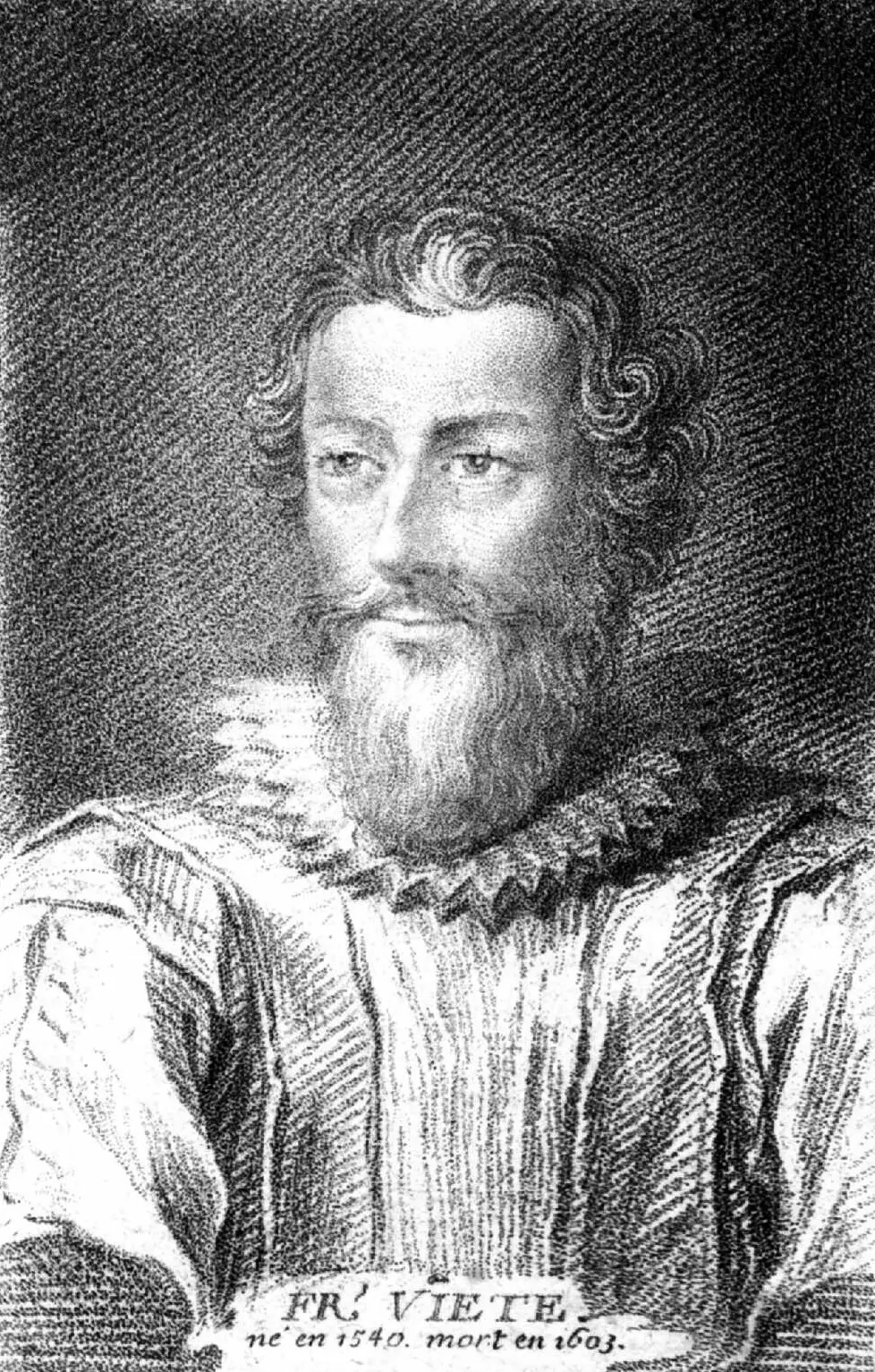
François Viète
François Viète was a French mathematician who was one of the first to use letters as parameters in polynomial equations. He also used decimal numbers and noted the elliptic orbits of planets forty years before Kepler. Viète also served as royal code-breaker to two kings, Henry III and Henry IV, and he developed methods for finding roots of polynomials which we’ll use here.
The discriminant of a polynomial provides information about the roots of the polynomial. For the quadratic polynomial , . For a general cubic , the discriminant is
For the cubic (5) , substituting :
Since , the cubic has three distinct real roots. This is known as the casus irreducibilis, a term for cubic equations with three distinct real roots whose solutions cannot be expressed using only real-valued radicals. Cardano’s formula produces the correct real answers, but only after taking cube roots of complex numbers. The standard resolution, due to François Viète, is a trigonometric substitution.
Trigonometric Solution
Starting from the depressed cubic in (6),
substitute :
The triple-angle identity gives , so
Choose to annihilate To annihilate a term in an equation means to make it zero. In this case, the goal is to choose a value for that makes the coefficient of the term equal to zero, simplifying the equation. the term:
The equation collapses to
The general solution to is . For this produces three distinct angles; the other family produces angles −10°,110°,230°, whose cosines equal cos(10°),cos(250°),cos(130°) respectively — the same three values in a different order. The three roots of (6) are therefore
corresponding to angles , , and .
Explicit Solutions
Since , the three values of are
| Angle | ||
|---|---|---|
Table: Solutions for .
All three roots are positive (the most negative cosine value, , gives ), confirming real solutions throughout. You may verify the Vieta formula checks: and .
The solutions to the original system are , with signs fixed by the recurrence. Taking the branch : since we have ; and since we have . Tracing the signs through (1) gives the principal solution
Numerically:
We can verify the sum directly:
Six Solutions
Other solution families arise from choosing different signs for the square roots or cycling the starting variable from or . The system is cyclic, but not symmetric. An arbitrary permutation like would require , i.e., , which is a different system altogether. Only cyclic permutations preserve the structure.
The 6 solutions come from two independent sources that multiply:
Factor 1 — 3 cyclic starting points. Once you pick which of the three roots plays the role of , the values of and are fully determined by the recurrence. With the principal solution , the other two are:
Factor 2 — global sign flip. Because , negating all three variables simultaneously maps any solution to another solution. So each of the three cyclic solutions above has a negative twin.
Summary
We studied the cyclic system , , and asked two questions: can we find explicit formulas for , and what is ?
The second question has a simple solution: 6. It follows from Vieta’s formulas applied to the cubic , which was derived by composing three times and requiring . No knowledge of the individual values of , , is needed. As a byproduct, the cyclic ratio sum satisfies .
For the explicit formulas, Cardano’s formula results in the casus irreducibilis: the discriminant confirms three distinct real roots, but the quadratic resolvent (9) has a negative discriminant, forcing complex intermediates. Viète’s trigonometric substitution resolves this by reducing the problem to . We found the three roots as , and the principal solution is , , .
Glossary
Circular equations. A system in which each variable is defined as a function of the next in a closed cycle. Here, under , making each variable a fixed point of .
Depressed cubic. A cubic polynomial with no quadratic term, . Tartaglia’s substitution (choosing to cancel the coefficient) converts any cubic to this form.
Cardano’s formula. The general closed-form solution to the depressed cubic, expressing the roots via cube roots of complex numbers when necessary. Published by Girolamo Cardano in Ars Magna (1545); the method was originally communicated by Niccolò Tartaglia.
Casus irreducibilis. Latin for “the irreducible case.” A cubic with three distinct real roots whose Cardano expression necessarily involves cube roots of non-real complex numbers. The trigonometric method (Viète, c. 1591) sidesteps this by working with angles rather than radicals.
Vieta’s formulas. For a monic polynomial with roots , the coefficients equal (up to sign) the elementary symmetric polynomials of the roots: , , , . These allow symmetric functions of the roots to be read directly from the coefficients, without solving the polynomial.
Triple-angle formula. . Used here to match the depressed cubic to the structure of a cosine identity, converting an algebraic equation into a straightforward trigonometric one.
Code for this article
The Julia code to solve this problem is available on Github. When you run it, you should expect to see:
=== Polynomial roots ===
  z_0 = 2.1372651…
  z_1 = 0.2576584…
  z_2 = 0.6050764…

=== Vieta checks ===
  Σ zₖ       = 3.0   (expect 3)
  Σᵢ<ⱼ zᵢzⱼ  = 2.0   (expect 2)
  Π zₖ       = 0.3333…   (expect 0.3333…)
  Σ 1/zₖ     = 6.0   (expect 6)

=== Final answers ===
  1/a² + 1/b² + 1/c²  =  6.0   (expect 6)
  b/a  + c/b  + a/c   =  -3.0  (expect −3)
Software
Julia - The Julia Project as a whole is about bringing usable, scalable technical computing to a greater audience: allowing scientists and researchers to use computation more rapidly and effectively; letting businesses do harder and more interesting analyses more easily and cheaply.
References
- Cardano, Girolamo. Ars Magna, sive De Regulis Algebraicis. Nuremberg, 1545. (First published solution of the general cubic and quartic.)
- “The Sum of the Sum of Some Numbers.” Wild Peaches, 14 April 2022. (Tartaglia’s Depression and the depressed cubic.)
- Stillwell, John. Mathematics and Its History, 3rd ed. Springer, 2010. Chapters 5–6. (Cardano, Viète, and the history of polynomial equations.)
- Viète, François. De Aequationum Recognitione et Emendatione Tractatus Duo. Paris, 1615 (posthumous). (Introduces the trigonometric method for the casus irreducibilis.)
- François Viète, Wikipedia.
- Vieta’s formulas, Wikipedia.
- Paraskevopoulos, Athanasios. François Viète and His Contribution to Mathematics. arXiv, 25 October, 2022. ( François Viète, known as the ”father of modern algebraic‘ notation”.)
- V. S. Varadarajan, Algebra in Ancient and Modern Times. American Mathematical Society, 1998.
- R. W. D. Nickalls, “A new approach to solving the cubic: Cardan’s solution revealed,” The Mathematical Gazette, vol. 77, no. 480, pp. 354–359, 1993.
Image credits
- Hero: Mount Baker, USA: WASHINGTON: North Cascades, Skagit Delta. PhotoSeek.com
- François Viète, Wikimedia Commons